Politics and Art – Ups and Downs and Ups
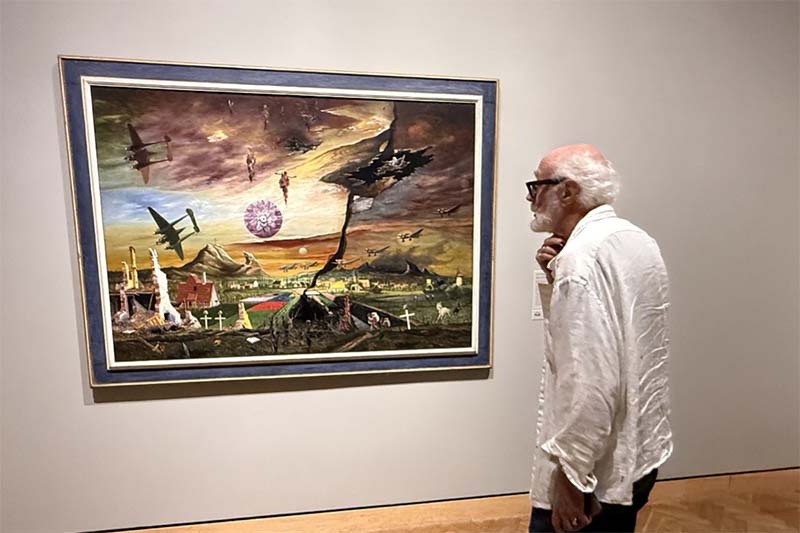
“Art matters,” I’ve been told a hundred times. I knew art could be interesting, perhaps appealing and even beautiful, but I hadn’t really understood the “mattering” part. So I finally went to the exhibition, Modern Art and Politics in Germany 1910-1945 at the Minneapolis Institute of Art before it closed in late July to try to understand this point better.
It was an excellent exhibit, a thoughtfully created presentation of German art from the period. To someone genuinely knowledgeable in art, the political undercurrents were perhaps visible, but I was greatly helped by the educational labels that accompanied each artwork, and others that introduced the larger themes as we moved from room to room.
I already knew a good bit about the politics of the time from writing my book, My Father Against the Nazis, but here’s what I’ve come to understand from this exhibition about the connection with art. Before 1933, Germany was still governed by the rules of democracy under the Weimar Constitution, and the Nazi party competed against many parties of the Left, Right, and Center. So-called Modern Art arose within this period. Artists, as well as writers, filmmakers etc., expressed through their art the troubled, anxious, fearful, and angry feelings prevalent among the German populace.
Such feelings were quite widespread; after all, Germany had recently lost the Great War against the Allied powers, shockingly losing its entire empire and its leadership. The newly installed Weimar Constitution and its democratically chosen government was struggling, and the economy was burdened by inflation and unemployment. Revolution was in the air and often in the streets, and both the far right and the far left were ascending. Times were definitely tough, for many if not most.
The Nazi Party was at its apex in 1932, having gained as much as 33% of the popular vote. It then managed to shed all its competition in 1933 when it maneuvered itself through both democratic and antidemocratic means to the highest conceivable level with dictatorial powers never before imagined. The resulting Nazi government abolished all other political parties and all democratic institutions and was in full control of everything
Its leaders, notably Adolf Hitler and his Minister of Propaganda Joseph Goebbels, actually cared about art, and readily identified which art furthered its agenda by conforming to Nazi ideals and which art did not. Art that ran against that ideal was denounced as “degenerate art” and those who created it from 1933 on were then in serious trouble. Artists labeled as degenerate could be sent to Dachau, a camp for political prisoners, for “re-education.” This happened to many artists – as well as journalists, teachers, writers, and others whose work was deemed anti-Nazi, or even potentially anti-Nazi. The threat of such imprisonment and forced re-education pushed many to flee the country, and encouraged those who remained to remove themselves from the public eye.
At one point I asked another MIA visitor whose path I occasionally intersected what she understood by the term “degenerate art” and she said, “I don’t know but it seems some people had an issue with it.” A good answer, I thought. The art on display was emotionally fraught. alienated. defiant, nose-tweaking art, outside-the-lines-of-authority, middle-finger-raised. It called out, “You got a problem with this art?”
Earlier forms of visual art – religious art, landscape art, portrait art, romantic art, representational art — didn’t typically express disgust or defiance. Expressing such feelings-with-attitude was revolutionary and it resisted the big ideas of the time, especially those ending with -ism. It questioned the very idea of authority.
Paintings showed families and communities increasingly oppressed by the dehumanizing technology brought on by the Industrial Revolution, and by economic developments that forced many all over the world to leave the pleasures of a simpler life and become part of a dehumanizing, soulless economy. I especially liked the painting of a thoroughly stylish (modern) woman, alone (modern), smoking a cigarette (modern), at a public (modern) outdoor café (modern), admiring the fast life passing by (modern), looking contented (modern), in her full power (modern), fairly reeking of liberation and defiant independence. No wonder the Nazis had an issue with it.
Such works that questioned authority and flaunted freedom didn’t conform to a moral ideal that respects the authority of Nazism – the authority of dominance and regimented discipline, the authority of a “morally correct exceptional Us against an unprincipled and degenerate Them,” or the authority of a Master Race, a Master Gender, and a Supreme Leader. The Nazis wanted art that showed the glory of strength through domination, with eyes to a future ordained in borders, blood and iron. The opposition’s art, the Nazis said, displays pain and weakness, dissolution and degeneracy.
Not only did the anti-democratic Nazis have an issue with art that spoke against their monopolistic ideas, they declared they had the power to banish it, as well as the power to banish and punish the artists creating it, and to send them to “re-education camps,” and later, worse. In 1940 the Nazis discovered they could enforce their agenda all over Europe, occupying and demanding conformance in all but a very few countries. That trend persisted until 1945, when once again, there was sufficient pushback from most of the world’s less autocratic governments to overpower and silence Nazified Germany, at least for the time being.
“So what?”, you might ask. One purpose of this Commentary and others on my Commentary page at StevenEMayerOnline.com is to explore the connection between my two seemingly different books, My Father Against the Nazis, and How to Save the World: Evaluating Your Options.
That second book (actually I wrote it before the book about my father) shows how you – yes you, personally – can play the role of activist/philanthropist and use your assets (everyone has some) and your native intelligence (ditto). My book gives guidance on how you can help “move the needle,” as the evidence-based nonprofit program evaluators might say, in arenas you care about, like Art, Democracy, Dignity, Creativity.
I like to think this little post says something about the power of art, and how art matters. Learning something about this myself is exactly why I went to this exhibition. So, if you too feel an enhanced appreciation of the power of art, then — as the message of my Save the World book explains — support more “art that matters.”
You can do this lots of ways. Speaking generally, you can give support to museums, to artists, to traffickers in art, to publicists, etc.
More specifically you can: Give support to museums with interests that overlap yours. Museums tend to be nonprofit organizations with the mission to stimulate interest, and preserve, enhance, and increase understanding and appreciation of a particular culture. They always need help, particularly with money and increased legitimacy, which they hope to use to make more progress in their mission. And by telling their story, they hope to attract more money to make more gains, in a virtuous circle. My How to Save the World book tries to help you, as a compassionate and also curious donor, make good choices that enable further progress.
You can also give support to artists themselves directly. Your money can contribute to an economy that expands creative and artistic expression in the world of ideas, an economy that employs real people and helps transmit the worthy cultures of the day to help shape the next. You can help them polish their talents so they shine.
You can also support narrators, knowledge workers, comedians, influencers and communicators in general, like those found all over the internet, in bookstores and cafes, in world-wide social media, communicating through independent channels of information, opinion, and skill development. You can give them good reason to stay engaged in the communication of ideas and ideals.
Let’s all get more creative in support of a more democratic and healthier society.